Preface#
The week's store opens its festive sale at 21:00. Ananya, in Jaipur, wants black shoes, and types the way she speaks: in Hinglish, in Latin letters, on a 4G phone. (An illustrative scene: the people, times and numbers are made up; each failure is a classic one.)
- 21:00:00 — The sale opens; typeahead traffic jumps ninefold. Every keystroke is a prefix query on Day 1's 50-million-product cluster, which hits 90% CPU: search slows for everyone
- 21:00:04 — Ananya types "kale j". Six requests leave in a second; the answer for "kal" arrives after the one for "kale j" and replaces it: "kalonji seeds"
- 21:00:05 — "kale joote" gets no suggestions: the list was built from English queries and only knows "black shoes"
- 21:02 — A phone launched at 20:00 is the country's top search. Typeahead doesn't know it: suggestions are rebuilt nightly, at 02:00
- 21:05 — A screenshot reaches support: typing "98" suggests a full mobile number, pasted into the box forty times by one person
None of these is a ranking or indexing bug. What broke is the box people type into: a separate system with its own traffic, data, privacy rules and failure modes, and one of the most asked interview questions there is: "Design typeahead."
Day 4 designs the search box. With ~100 ms per keystroke the server gets about 15 ms, and one search is ~12 requests: ~2,800 searches a second at peak become ~33,000 typeahead requests. The app debounces (100–150 ms), filters locally, caches per prefix and discards stale answers; the CDN caches the global list by prefix and locale, so ~11,000 requests a second reach it and ~4,400 the origin. A trie stores the top-k at every node, served as a prefix → list map. Suggestions are built nightly from query logs (distinct users, a 14-day half-life, filters for fewer than 20 users, PII and policy, a serve-time blocklist), with a 5-minute trending overlay and versioned snapshots. The ~11 GB index is replicated, not sharded (hash the prefix if it must be); history stays private; spelling uses P(c) · P(w | c); facets use post_filter.
Yesterday (Day 3) ranked results once a query is submitted. Today covers what happens around it: suggestions while the user types, "did you mean" when they get it wrong, and facets to narrow what comes back.
Part I: Foundations#
Chapter 1: What Typeahead Has to Do#
1.1 The Simple Definitions#
- Typeahead (autocomplete): as the user types a prefix, show the top-k (usually 5–10) likely completions, updated on every keystroke.
- Query suggestions complete the query ("samsung s24 cover"); instant results show entities (a product, a person). Many boxes show both.
- Zero-prefix state: what shows before anything is typed: recent and trending searches.
Google states the goal well: "Autocomplete is designed to help people complete a search they were intending to do, not to suggest new types of searches to be performed" (Google, 2018). The same post says autocomplete "reduces typing by about 25 percent" on average.
1.2 The Latency Budget per Keystroke#
A suggestion that arrives after the next keystroke is useless. Facebook's 2010 description of its typeahead put the line at 100 ms: "spending more than 100 msec to retrieve a result will cause the typeahead to 'stutter,' leading to a bad user experience" (Facebook Engineering, 2010). Spend those 100 ms like this (an illustrative budget for mobile users in India):
| Slice | Budget | Note |
|---|---|---|
| Phone to CDN edge and back | ~50 ms | 4G round trip |
| Edge to origin and back | ~25 ms | Only on a cache miss |
| Typeahead service, p99 | ≤ 15 ms | What's left |
| Render | ~10 ms | Client |
The server gets about 15 ms: a lookup, not a query that scores millions of documents. And the cheapest request is one the CDN or browser answers.
1.3 One Search, Many Requests#
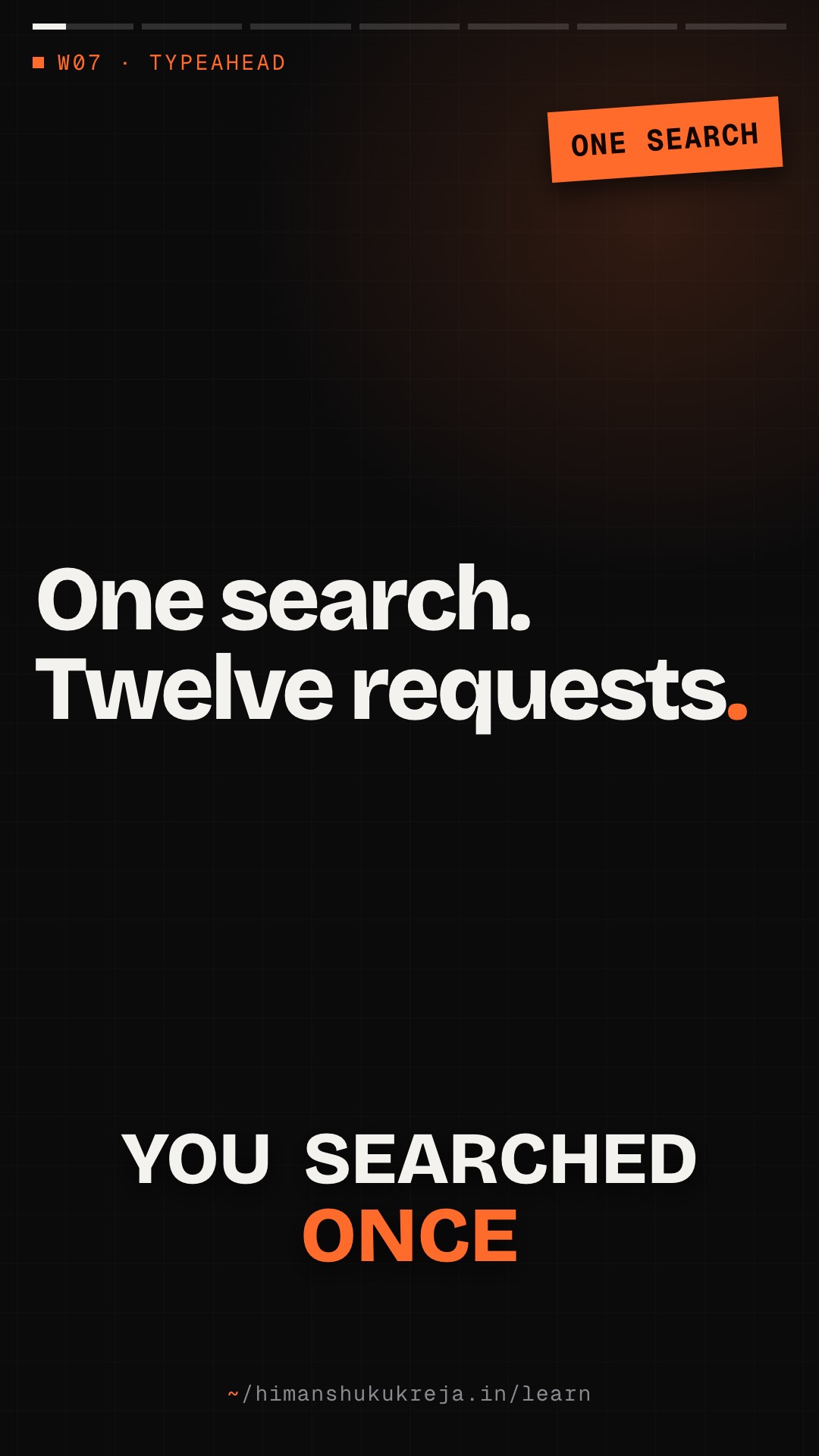
Typeahead sends one request per keystroke, not per search. That QPS amplification is the number that surprises people.
Before the numbers: what does typeahead cost per search?
The store has 10 million daily users who each run 8 searches a day; peak is 3× the average. Users type about 12 characters before they pick a suggestion or press Enter. If the client sends a request on every keystroke, how many typeahead requests a second arrive at peak, and how does that compare with the searches themselves? The product search cluster from the week's preview is sized for about 10,000 searches a second.
One strong answer
- Searches: 10M × 8 = 80M a day ÷ 86,400 ≈ 930/s, ×3 ≈ 2,800 a second at peak.
- Typeahead: 2,800 × 12 ≈ 33,000 requests a second: twelve times the searches.
- So if each keystroke were a search-cluster query, typeahead alone would need over three times the cluster built for search. It has to be a different, much cheaper system.
1.4 The Client's Half: Debounce, Cancel, Discard Stale#
Half of typeahead runs in the app, and it removes most of the load and the flicker:
- Debounce: send only after a short pause (100–150 ms, illustrative), so "kale j" sends one or two requests, not six. That delays every suggestion, so:
- Filter locally first: the "kal" list filtered to "kale…" is an instant placeholder (it can miss entries outside "kal"'s top-k).
- Cache per prefix in the tab: backspace and retyping are free.
- Cancel and sequence: abort the old prefix's request, and never let an older response overwrite a newer one.
let timer, controller, latest = 0;
const cache = new Map();                          // prefix -> suggestions, this tab only

input.addEventListener("input", () => {
  const prefix = normalize(input.value);          // lowercase, trim, Unicode NFKC
  clearTimeout(timer);
  controller?.abort();                            // the previous prefix no longer matters
  latest++;                                       // so no answer already in flight may render
  if (cache.has(prefix)) return render(cache.get(prefix));     // backspace or retype: free
  renderFilteredFromLastList(prefix);             // instant placeholder while we wait
  timer = setTimeout(() => load(prefix), 120);    // send only after a pause in typing
});

async function load(prefix) {
  controller = new AbortController();
  const seq = ++latest;
  try {
    const res = await fetch(`/suggest?q=${encodeURIComponent(prefix)}&loc=hi-IN`,
                            { signal: controller.signal });
    const items = await res.json();
    cache.set(prefix, items);
    if (seq === latest) render(items);            // an old answer never replaces a newer one
  } catch (e) {
    if (e.name !== "AbortError") renderFilteredFromLastList(prefix);   // fail quietly
  }
}
The sequence check alone fixes "kalonji seeds": latest moves on every keystroke, so an answer still in flight fails seq === latest. abort() saves the client's work, not the server's, so the server must be cheap anyway.
Chapter 2: Data Structures for Prefix Lookup#
2.1 A Trie, and Why a Plain One Is Too Slow#
A trie (prefix tree) stores strings character by character; every path from the root spells a prefix. Finding the node for "sam" takes 3 steps, however many queries are stored.
The trouble is listing completions: you must visit and rank every query below that node. Below "sam" there may be thousands; below "s", millions. The short prefixes users type most have the biggest subtrees, so the work is largest where traffic is highest.
2.2 Top-k Precomputed at Every Node#
The fix: store the answer, not the means to compute it. At build time every node keeps its own top-k list, so serving is "walk the prefix, return the list": O(prefix length), no subtree walk.
%% title: A trie over six past queries, each node keeping its top 3
flowchart TD
  R(("root"))
  S["s<br/>saree · samsung s24 · shoes"]:::core
  SA["sa<br/>saree · samsung s24 · samsung tv"]
  SH["sh<br/>shoes · shirt"]
  SAR["sar<br/>saree"]
  SAM["sam<br/>samsung s24 · samsung tv"]
  SAN["san<br/>sandals"]
  SHO["sho<br/>shoes"]
  SHI["shi<br/>shirt"]
  R --> S
  S --> SA
  S --> SH
  SA --> SAR
  SA --> SAM
  SA --> SAN
  SH --> SHO
  SH --> SHI
(Illustrative scores behind it: saree 9,100, samsung s24 8,400, shoes 7,700, samsung tv 3,200, sandals 2,900, shirt 2,100.)
import heapq

K = 10

class Node:
    __slots__ = ("children", "top")
    def __init__(self):
        self.children = {}          # character -> Node
        self.top = []               # min-heap of (score, query), at most K entries

def insert(root, query, score):
    """Build time. Called once per distinct query, with its final score (Chapter 3)."""
    node = root
    for ch in query:
        node = node.children.setdefault(ch, Node())
        if len(node.top) < K:
            heapq.heappush(node.top, (score, query))
        elif score > node.top[0][0]:
            heapq.heapreplace(node.top, (score, query))    # evict this node's current K-th best

def suggest(root, prefix):
    """Serve time: O(len(prefix)) to find the node, then the list is already there."""
    node = root
    for ch in prefix:
        node = node.children.get(ch)
        if node is None:
            return []
    return [q for _, q in sorted(node.top, reverse=True)]
The costs moved to build time:
- Memory: k entries per node; store 4-byte ids into a suggestion table, not strings.
- Updates: a score change touches every node on the query's path, so suggestion indexes are rebuilt in batch and swapped (Chapter 3).
- Fixed k: a top-10 list can't answer "top 20". Pick k for the UI, plus headroom for serve-time filtering.
And a serving trick: with every list precomputed, you don't need the trie at serve time. A key-value map from prefix to list answers with one lookup, and shards like any key-value store (Chapter 4).
2.3 An FST: The Trie, Compressed#
A trie shares prefixes; a finite-state transducer (FST) also shares suffixes ("running shoes" and "walking shoes" end in the same states). Lucene builds a minimal FST in one pass over input that "must be sorted", into "a compact serialized format byte array" (Lucene FSTCompiler docs). Mike McCandless built one for the 9.8 million unique terms of a Wikipedia index in about 8 seconds: 69 MB (2010).
For suggestions, Lucene's weighted-FST suggester puts weights on the paths and "first traverses the prefix, then walks the n shortest paths to retrieve top-ranked suggestions" (Lucene WFSTCompletionLookup docs). Same idea as stored top-k, done by a best-first search. Lucene's AnalyzingSuggester indexes the analyzed form while returning the original: "ame…" suggests "Amélie" through case and accent folding (McCandless, 2012). Remember that trick for Hinglish (Chapter 4.6).
The price: an FST is immutable; you rebuild it, never edit it.
2.4 What a Search Engine Gives You#
Elasticsearch and OpenSearch offer four options; prefix matching "happens at query time", "the other three methods happen at index time" (OpenSearch docs):
- Prefix queries (
match_phrase_prefix): no special mapping, but "a fairly resource-intensive operation. A prefix of a could match hundreds of thousands of terms" (OpenSearch docs). Fine for an admin tool, wrong for a public box. - Edge n-grams: each word is indexed with every prefix ("nike" → n, ni, nik, nike), so a typed prefix is an exact term lookup. Search with a plain analyzer, "otherwise, the search query splits into edge n-grams" and matches everything (OpenSearch docs); and "search terms longer than the max_gram length may not match any indexed terms" (Elasticsearch docs).
search_as_you_type: shingle subfields (._2gram,._3gram) plus an edge n-gram._index_prefix, queried withbool_prefix, so words match in any order (Elasticsearch docs).- The completion suggester: a
completionfield built into an FST that "lives in memory and is optimized for fast prefix lookups" (OpenSearch docs); Elastic says its structures "are costly to build and are stored in-memory". Each input has a weight, returned as_score, with optional fuzzy matching (by default from 3 typed characters, first character exact) and up to 10 contexts such as category (Elasticsearch docs).
Standard tokenization stores "nike" as one token, so the prefix "ni" matches nothing exactly. Edge n-grams store n, ni, nik and nike (and every prefix of nikon) at index time; at search time the analyzer only lowercases, so "ni" is one exact lookup returning nike and nikon, nike first on a sports site.
2.5 Choosing#
Trie / prefix map with top-k · your own service
- Lookup: one walk or one key; microseconds
- Ranking: anything you can compute offline
- Freshness: rebuild and swap, plus an overlay for trending
- Filters: only those built in (per locale, per category list)
- Best for: query suggestions at very high QPS
Completion suggester · FST in the engine
- Lookup: in-memory FST, very fast
- Ranking: a static weight per input
- Freshness: new suggestions visible after a refresh
- Filters: up to 10 contexts; prefix of the input only
- Best for: entity names at moderate QPS, without a new service
Edge n-grams / search_as_you_type · a full query
- Lookup: a real search: scoring, fan-out to shards
- Ranking: full query DSL: popularity, boosts, personalization
- Freshness: as fresh as the index (Day 2)
- Filters: any: in stock, price, user's region
- Best for: instant product results with rich filters, behind a cache
The usual production answer is two lists in one dropdown: query completions from a precomputed index, and a few instant entity results from the search engine, fetched in parallel and merged.
Pick the structure for three boxes
(a) The store's main box: query suggestions, 33,000 keystrokes a second at peak. (b) The seller dashboard: a seller's own 5,000 product names, in stock only, a few requests a second. (c) People search on a professional network, the user's connections first. Choose for each, and why.
One strong answer
- (a) A precomputed prefix → top-k service: rankings come from logs offline, and the answer is the same for everyone, so the CDN can cache it.
- (b) Edge n-grams or
search_as_you_type: low QPS affords a real query, and live filters (seller, in stock) need one. - (c) A per-user structure, since answers differ per user: LinkedIn's Cleo ranked by the user's network (4.5); Facebook loaded connections into the browser (4.2).
Part II: Building Suggestions#
Chapter 3: From Query Logs to a Suggestion Index#
Query suggestions come from what people searched: Google's "autocomplete predictions reflect real searches that have been done on Google" (Google Search Help). So the build is a batch pipeline over search logs, plus a streaming path for what's new.
%% title: Building suggestions: a nightly batch, a streaming overlay, a serve-time kill switch
flowchart TD
  LOG@{ icon: "sd:log", label: "Search events<br/>query, user, results, clicked, time" }
  LAKE@{ icon: "sd:object-storage", label: "Daily partitions<br/>last 90 days" }
  AGG@{ icon: "tech:spark", label: "Spark batch, nightly<br/>normalize · count · decay" }
  FIL["Filters<br/>PII · blocklist · min distinct users"]:::core
  BUILD["Build snapshot v1042<br/>prefix → top-k per locale"]:::core
  SNAP@{ icon: "sd:object-storage", label: "Versioned snapshots" }
  K@{ icon: "tech:kafka", label: "Kafka<br/>search events" }
  FL@{ icon: "tech:flink", label: "Flink<br/>5-minute counts vs baseline" }
  TR["Trending overlay<br/>stricter filters · short TTL"]:::hot
  SRV@{ icon: "sd:servers", label: "Typeahead replicas<br/>load · verify · swap" }
  LOG --> LAKE --> AGG --> FIL --> BUILD --> SNAP --> SRV
  LOG --> K --> FL --> TR --> SRV
  class LOG,LAKE,SNAP store
  class AGG,FL service
  class K queue
  class SRV service
3.1 Aggregation#
- Normalize each query: Unicode NFKC, lowercase, collapse spaces, strip trailing punctuation. Keep a trailing space meaningful: "nike " means the word is finished, so it shouldn't suggest "nikon".
- Count per query per day: searches, distinct users (so one bot can't manufacture a suggestion) and successful searches, followed by a click or add-to-cart (so useless queries aren't promoted).
- Collapse variants ("Samsung S24", "samsung s24") into one suggestion, shown in its most common form.
3.2 Decay#
All-time counts never forget: a phone from three years ago outranks this year's model forever. Weight each day's count by its age, with a half-life:
from collections import defaultdict

HALF_LIFE_DAYS = 14     # illustrative: news-like catalogues want days, slow ones months
MIN_USERS = 20          # never suggest what fewer than 20 different people typed (illustrative)

def score_queries(daily_rows, users_90d, today, blocked):
    """daily_rows: (day, query, searches, successes) for the last 90 days.
    users_90d: query -> distinct users over the window (from a HyperLogLog sketch)."""
    score = defaultdict(float)
    for day, q, searches, successes in daily_rows:
        age = (today - day).days
        weight = 0.5 ** (age / HALF_LIFE_DAYS)             # 14 days old counts half
        score[q] += weight * (searches + 2 * successes)     # reward searches that went somewhere
    return {q: s for q, s in score.items()
            if users_90d.get(q, 0) >= MIN_USERS and not blocked(q)}
The half-life is a product decision: short is responsive and jumpy, long is stable and stale. With two weeks, seasonal queries ("diwali lights") rise each October or November from that year's searches.
3.3 Filtering: Offensive, PII and Rare Queries#
A suggestion is the system speaking: it puts words in front of a user who didn't type them. Google says autocomplete "has systems designed to prevent potentially unhelpful and policy-violating predictions from appearing" ("violent, sexually explicit, hateful, disparaging, or dangerous"), including "unconfirmed rumors after a news event" (Google Search Help); "enforcement teams" remove what automation misses, and the policies "only apply to predictions. They do not apply to search results" (Google, 2020).
A typical filter stack, in build order:
- Minimum distinct users (
MIN_USERS): the key privacy filter. One person's query can hold their name or phone number; a crowd threshold keeps it out of everyone else's dropdown. The preface's number had 40 searches from one user. - PII patterns: phone numbers, emails, 12-digit identity numbers, order and card numbers. Drop, don't mask.
- Blocklists and a classifier per language, including transliterated slurs.
- Policy lists: people's names, medical conditions, whatever legal calls sensitive.
- A serve-time blocklist, updatable in seconds: a bad suggestion found at 21:05 can't wait for the 02:00 build.
3.4 Freshness: the Trending Path#
A nightly batch can't know about the 20:00 launch. Google lists "trending interest in a query" among its signals (Google Search Help). A typical design:
- A stream job counts queries per locale in 5-minute windows against each query's baseline.
- Several times the baseline, from enough distinct users, enters a small trending overlay with a TTL of hours.
- At serve time the overlay is merged into the top-k, capped at one or two slots.
- The overlay gets stricter filters, not looser: new things are where rumours and coordinated abuse live.
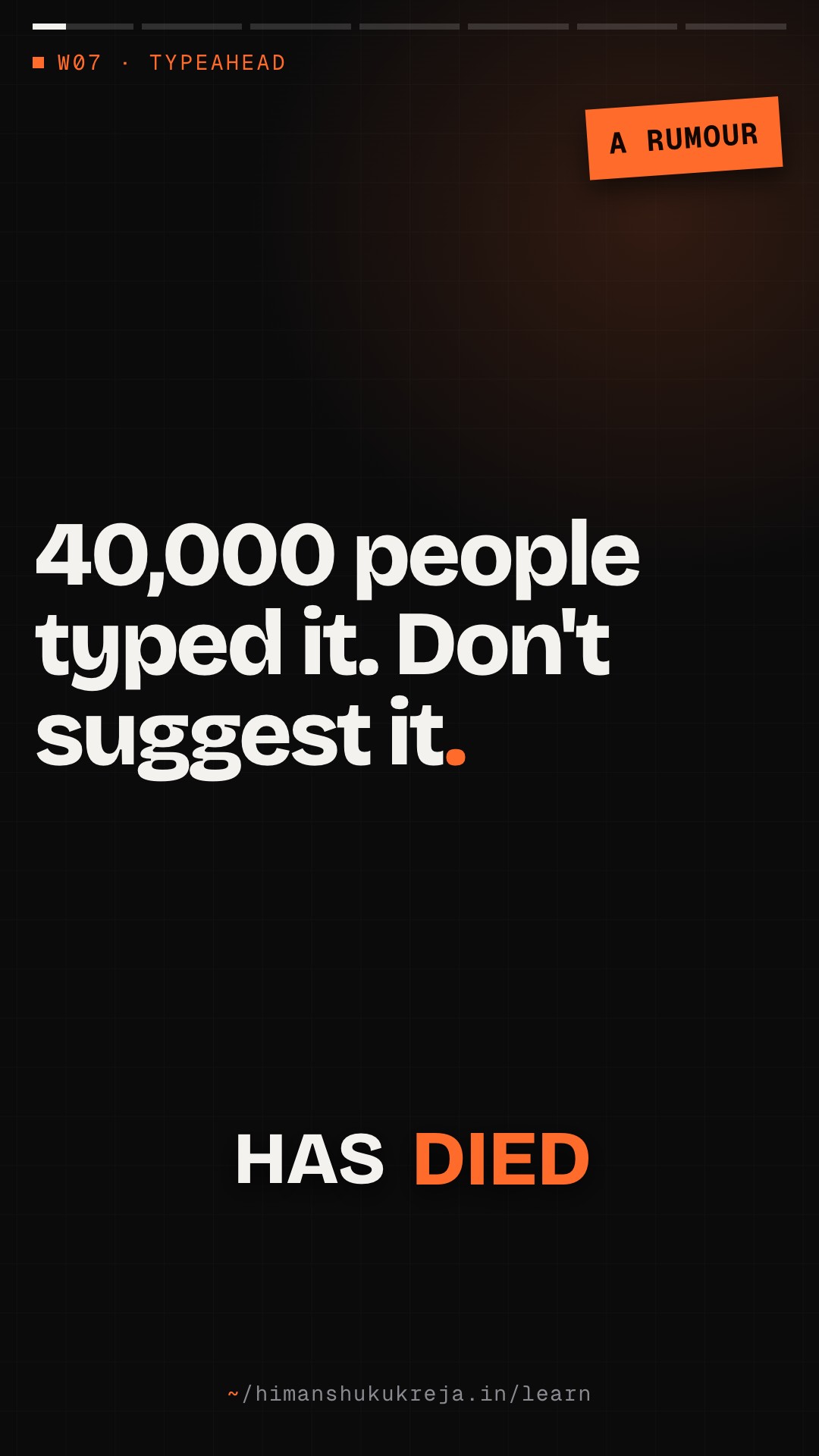
A rumour trends at 23:00
An unconfirmed rumour says a well-known actor has died. Within 15 minutes "[actor's name] death" is the fastest-rising query, from 40,000 distinct users, and the trending path is about to add it to every prefix of the name. What should happen, and which mechanisms make it possible?
One strong answer
- Don't suggest it. It passes the crowd test, but suggesting it makes the system the rumour's amplifier. Google filters exactly this: "unconfirmed rumors after a news event".
- Mechanisms: a policy filter on named people plus death, crime or health terms; trending entries about people wait for human review.
- Search still works for anyone who types the full query; only the suggestion is held back.
- If it slipped through: the serve-time blocklist and a CDN purge remove it in seconds.
3.5 Building and Shipping a Snapshot#
The batch writes a versioned, immutable snapshot per locale, shipped like Day 2's alias swap (Day 2 · Zero-Downtime Reindexing):
- Validate: entry counts near yesterday's, a golden set ("sa" must contain "saree"), no blocked term.
- Load beside the old one, warm, swap a pointer; keep yesterday's for rollback.
- If the build fails, serve the last good snapshot. Stale for a day is fine; empty is an outage.
Part III: Serving at Scale#
Chapter 4: The Serving Path#
4.1 From Keystroke to Dropdown#
%% title: Typeahead serving: most keystrokes never reach the origin
flowchart TD
  U@{ icon: "sd:phone", label: "App or browser<br/>debounce · tab cache · local history" }
  CDN@{ icon: "sd:cdn", label: "CDN edge<br/>key: prefix + locale<br/>TTL ~10 min" }
  API@{ icon: "sd:api", label: "Suggest API<br/>normalize · route by locale" }
  TA["Typeahead service<br/>prefix → top-k in memory<br/>a full copy per replica"]:::core
  TR["Trending overlay<br/>merged at serve time"]:::service
  BL["Serve-time blocklist<br/>updates in seconds"]:::service
  PH@{ icon: "sd:cache", label: "Personal history<br/>per user, behind login" }
  SE@{ icon: "tech:elasticsearch", label: "Product index<br/>instant results, cached" }
  U -->|"miss"| CDN
  CDN -->|"miss"| API
  API --> TA
  TA --> TR
  TA --> BL
  U -.->|"signed in, separate call"| PH
  API -.->|"instant results, after 3 characters"| SE
  class U client
  class CDN edge
  class API edge
  class PH cache
  class SE store
The global list is the same for everyone with the same prefix and locale, so it can be cached anywhere; the personal part travels separately.
%% title: Ananya types kale, then backspaces
sequenceDiagram
  autonumber
  participant A as Ananya
  participant C as App
  participant E as CDN edge
  participant T as Typeahead service
  A->>C: k, a, l, 110 ms apart
  C->>C: debounce, nothing sent yet
  A->>C: pause after kal
  C->>E: GET suggest q=kal loc=hi-IN
  E->>T: miss, forward
  T-->>E: top 8, cacheable 10 min
  E-->>C: kale joote, kala chashma, kalonji seeds
  A->>C: types e
  C->>C: show kal list filtered to kale at once
  C->>E: GET suggest q=kale loc=hi-IN
  E-->>C: hit, answered at the edge
  A->>C: backspace to kal
  C->>C: tab cache hit, no request
4.2 Caching in the Browser and at the CDN#
In the browser. Facebook's 2010 typeahead went furthest: "As soon as the user focuses in the text box, we send off a request to retrieve all of the user's friends, pages, groups, applications, and upcoming events. We load these results into the browser's cache", and later results were cached too, "so that similar subsequent queries don't need to hit the backend again" (Facebook Engineering, 2010). For a small personal set, shipping all of it to the client turns typeahead into local filtering.
At the CDN. Global suggestions are cacheable responses: GET /suggest?q=sam&loc=en-IN with Cache-Control: public, max-age=600. Short prefixes are the most requested and the most cacheable: a locale has only about 700 one- and two-letter Latin prefixes (26 + 26²), which can live at the edge or ship to the app as a static file. Key on the normalized prefix plus locale only; a user id in the key turns a 60% hit ratio into zero. The TTL (ten minutes, illustrative) sets how fast new snapshots reach users; removals use a purge.
4.3 Sharding by Prefix and the Hot-Prefix Problem#
If one copy doesn't fit on a machine, you must split it. The obvious split, by first letter, is the classic wrong answer.
What breaks if you shard by first letter?
The index is split into 26 shards, one per first letter. On launch night everyone types "iph…". What goes wrong, and how would you split it instead?
One strong answer
- Skew: first letters aren't uniform, so a few shards always carry several times the average, the weakness of fixed key ranges (Week 1, Day 1 · Partitioning).
- Hot spots: a launch puts every "i…" request on one shard (Week 1, Day 4 · Hot Keys and Skew).
- Better: each request needs one key, so hash the whole prefix: "i", "ip" and "iph" land on different shards, and a hot prefix is one hot key for the CDN, replicas and coalescing.
- Best, when it fits: don't shard; replicate the full index (the calc below shows it fits).
When the CDN entry for a hot prefix expires, many edges ask at once. Coalescing, one fetch per key with the rest waiting for it, is the thundering-herd fix from Week 4.
4.4 Sizing It#
| Value | |
|---|---|
| Daily users × searches each (assumed) | 10 million × 8 = 80 million a day |
| Searches: average / peak at 3× | ~930 a second / ~2,800 a second |
| Keystrokes per search (assumed) | 12 → ~33,000 requests a second with no debounce |
| With debounce and the tab cache (assumed ~4 requests a search) | ~11,000 a second reach the CDN |
| CDN hit ratio (assumed 60%: short prefixes dominate) | ~4,400 a second reach the origin |
| Distinct suggestions kept after filters (assumed) | 20 million, ~20 characters each |
| Distinct prefixes (assumed: 400 million characters, shared prefixes cut it to ~120 million) | ~120 million keys |
| Per prefix: 10 suggestion ids × 4 B + key and map overhead ~40 B | ~80 B → ~10 GB |
| Suggestion table: 20 million × ~50 B (text, score, category) | ~1 GB |
| One replica (assumed: ~20,000 lookups a second on 16 cores) | 4,400/s needs one; run 3 per region for failures and deploys |
Conclusion: the amplification is real (12× the searches), but debouncing and the CDN cut the origin's load sevenfold, and the whole index, about 11 GB, fits in one machine's memory. So give every replica a full copy and don't shard; hash-shard by prefix only when many locales or a far bigger catalogue outgrow one machine.
4.5 Personalization Blending#
Google's suggestions consider "your past searches", and signed-in users may see "personalized predictions based on their activity on Google" (Google Search Help). LinkedIn's Cleo split typeahead into generic (the same results for everyone, "ordered according to a global ranking scheme") and network typeahead, ranked within a member's 1st- and 2nd-degree connections using "People You May Know" scores, at "~20 milliseconds on average" for more than 150 million members (LinkedIn Engineering, 2012). Cleo maps "string prefixes (or members) to documents", uses Bloom filters as "a fast means to filter documents that cannot prefix-match", and a forward index to drop their false positives.
A typical blend keeps the cacheable and personal parts apart and merges them on the client or in a thin authenticated call:
def blend(prefix, global_top, history, affinity, k=8, history_slots=2, w=0.3):
    """global_top: [(query, score, category)] for this prefix: the same for everyone, cacheable.
    history: this user's recent queries, newest first. affinity: {category: 0..1} for this user."""
    past = [q for q in history if q.startswith(prefix) and q != prefix][:history_slots]
    reranked = sorted(global_top,
                      key=lambda t: t[1] * (1 + w * affinity.get(t[2], 0.0)),  # nudge, never filter
                      reverse=True)
    return (past + [q for q, _, _ in reranked if q not in past])[:k]
Three rules: cap the personal slots; mark history and let users delete it (Google shows a clock icon on mobile and "Remove" on desktop, 2018); and never cache a blended response at a shared key.
What breaks if the CDN caches the blended list?
A teammate moves blend() to the origin and lets the CDN cache /suggest?q=pr&loc=en-IN for ten minutes, as before. Ananya, signed in, recently searched "pregnancy test". What goes wrong, and what's the fix?
One strong answer
- A privacy leak: whoever misses first sets the entry. If that's Ananya, everyone typing "pr" at that edge sees "pregnancy test" from her history for ten minutes.
- And the reverse: she gets someone else's list, without her history.
- Fix: the CDN only sees the global list; history comes
Cache-Control: privatebehind login, or from the device, merged on the client. Blending on the server meansprivate, no-storeand no caching.
4.6 Multi-Language and Transliteration#
Flipkart's data scientists reported that "apart from English, the major portion of the queries (around 21%)" on their platform was "code-mixed Hinglish i.e. queries where one or more Hindi words are written in Latin script", with examples like "kale jute 300 tak" and "mbile phone ki battry" (Flipkart Data Science, 2022). For full searches they translate the query into English with a transformer, distilled for "more than 4x reduction in latency" and live "serving millions of queries".
A model call per search is affordable; per keystroke it pays the 12× amplification. So a typical typeahead design moves language work into the build:
- Per-locale indexes (
hi-IN,en-IN,ta-IN), with English as a fallback. - Several keys, one suggestion. Like the AnalyzingSuggester (2.3), index "black shoes / काले जूते" under what users type: "kale joote", "kale jute", "kaale joote", "काले जूते", generated by transliteration plus phonetic normalization (collapse doubled vowels, merge common spellings).
- Mine mappings from logs: users who typed "joote", then searched "shoes" and clicked. These are one-way synonyms: "joote ⇒ shoes" widens the Hinglish query without adding Hinglish to English results.
- Show the user's script, and normalize Unicode (NFKC) on keys and prefixes, since one Devanagari word can be encoded more than one way.
Part IV: After Enter: Spelling and Facets#
Chapter 5: "Did You Mean"#
Typos that get past typeahead reach search, where Day 3 already relaxes queries with fuzzy matching. Spelling correction is the explicit version: propose the query the user meant.
5.1 Edit Distance and Candidates#
Edit distance (Levenshtein) counts the single-character insertions, deletions and substitutions between two strings; Damerau's variant counts a swap of adjacent letters as one. Elasticsearch's fuzziness allows at most 2 edits; AUTO allows none for 1–2 characters, one for 3–5, two above 5 (Elasticsearch docs).
Comparing against every term is too slow. The old Lucene FuzzyQuery "visits every single unique term in the index"; Lucene 4.0 instead intersects a Levenshtein automaton, which accepts exactly the strings within the distance, with the sorted terms dictionary; with that and other term-seeking improvements, FuzzyQuery got about 100 times faster (McCandless, 2011).
5.2 The Noisy Channel#
Edit distance makes candidates; it doesn't choose. "adres" is one edit from "acres", two from "address". Peter Norvig's essay derives the choice with Bayes' theorem; it is the classic noisy channel model: the user meant c, the keyboard garbled it into w, so pick
argmax over candidates c of P(c) · P(w | c)
where P(c), the language model, is how common c is, and P(w | c), the error model, is how likely that typo is when someone means c (Norvig, 2007–2016). His toy version ranked every one-edit word above any two-edit word, so it turned "adres" into "acres"; it scored 75% on his development set and 68% on the test set. The fix is a real error model, learned from users correcting themselves.
def correct(word, candidates, query_freq, error_prob):
    """candidates: known queries within 2 edits. query_freq: counts from your own search logs.
    error_prob(w, c): P(typed w | meant c), learned from users' own reformulations."""
    total = sum(query_freq.values())
    return max(candidates | {word},
               key=lambda c: (query_freq.get(c, 0) / total) * error_prob(word, c))
For search, your own query logs are the language model, not a dictionary: "s24" and "boAt" are real words no dictionary has. Context matters too: the neighbouring word decides whether "strp" is "strap" or "strip".
Errors aren't only slips. Amazon's scientists described phonetic errors, like "blutut sant sistam" for "bluetooth sound system" and "nacklesh" for "necklace"; on India's e-commerce market, adding phonetics improved F1 "by 9%+" and phonetic-error recall "by 8%+", "without additional latency cost" (Amazon, 2022).
5.3 In a Search Engine#
Elasticsearch ships the pieces (Elasticsearch docs). The term suggester "suggests terms based on edit distance", one word at a time. The phrase suggester picks "entire corrected phrases" using "ngram-language models", a noisy channel over word shingles; real_word_error_likelihood (default 0.95) admits that correctly spelled words can be wrong in context, and confidence sets how much better a correction must score. collate prunes "suggestions for which no matching docs exist in the index".
5.4 Correct, or Only Suggest?#
| Situation | Do | Why |
|---|---|---|
| Original returns nothing, correction returns plenty, high confidence | Auto-correct: "Showing results for address", with a link to search the original | The user wanted results, not a question |
| Both return results, correction is much stronger | Suggest: "Did you mean address?" above the original's results | The original might be intentional |
| A new brand or product name looks like a typo | Neither: whitelist catalogue terms | Correcting a real new product is the worst error |
Tune the thresholds with Day 3's metrics: zero-result rate, and clicks on the correction versus the original.
Chapter 6: Faceted Filtering#
6.1 Facets Are Aggregations#
Facets are the counts beside the results (illustrative counts): Brand: Nike (892), Adidas (567); Price: under ₹1,000 (234). Each is an aggregation over the matching documents (terms on brand, range on price), computed in the same request as the hits, on keyword and numeric fields (Day 1's multi-field pattern). Selections go in filter context (Day 3).
6.2 Multi-Select: Facets Ignore Their Own Filter#
When Ananya ticks "Nike", results narrow to Nike, but the brand facet must still count Adidas and Puma, or she can't add a second brand; every other facet narrows to Nike. Elasticsearch: "Search requests apply post filters only to search hits, not aggregations" (Elasticsearch docs). Then wrap each facet in a filter aggregation with every selection except its own:
{
  "query": { "bool": { "must": { "match": { "name": "running shoes" } },
                       "filter": [ { "term": { "in_stock": true } } ] } },
  "post_filter": { "bool": { "filter": [ { "terms": { "brand": ["nike"] } },
                                         { "term": { "color": "black" } } ] } },
  "aggs": {
    "brand": { "filter": { "term": { "color": "black" } },
               "aggs": { "values": { "terms": { "field": "brand", "size": 20 } } } },
    "color": { "filter": { "terms": { "brand": ["nike"] } },
               "aggs": { "values": { "terms": { "field": "color", "size": 15 } } } }
  }
}
Hits get both selections; the brand facet ignores the brand selection; the color facet ignores the color selection.
6.3 Counts Are Approximate at Scale#
A terms aggregation takes each shard's top shard_size values, by default "size * 1.5 + 10", and merges them, so a value just below every shard's cut-off is undercounted: "doc_count values for a terms aggregation may be approximate" (Elasticsearch docs). For facets that's usually fine; raise shard_size where a missing value would be noticed, and put facets with thousands of values behind "show more".
6.4 Facets in the Typeahead#
Today's halves meet in the dropdown: "nike running shoes in Men's Footwear". A typical design stores with each suggestion the categories its searches ended in (from clicks) and offers one or two as scoped suggestions, which run the search with that facet selected and resolve the preview's "apple" ambiguity.
Chapter 7: Edge Cases and Failure Modes#
Two cases the matrix below doesn't show. Very long input: cap prefixes at ~50 characters (illustrative) and answer from the last list. A user deletes their history: delete it from the personal store at once; the global list needs nothing, because a query only reaches it after enough different people typed it.
| Failure | Users see | Contained by |
|---|---|---|
| Slow network, fast typist | Flicker, wrong list | Debounce, abort, sequence check |
| Nightly build fails | Yesterday's suggestions | Last good snapshot |
| Offensive or PII suggestion found | Gone in seconds | Serve-time blocklist, CDN purge |
| Hot prefix on a launch | Nothing unusual | CDN, replicas, request coalescing |
| Personalized list cached publicly | Someone else's history | Global-only cache keys, private history call |
| Typeahead service down | No dropdown; search works | Client timeout, graceful hide |
Part V: Real-World Application#
Chapter 8: How Real Companies Do It#
| Source | What it has published |
|---|---|
| Google (2018, 2020, Search Help) | Predictions from real searches, by language, location, trend and past searches; ~25% less typing; policy filters plus enforcement teams; rumours filtered; policies cover predictions, not results |
| LinkedIn Cleo (2012) | Generic vs network typeahead; prefix index, Bloom filters, forward index; PYMK ranking; network typeahead ~20 ms average for 150M+ members |
| Facebook (2010) | 100 ms "stutter" line; connections bootstrapped into the browser cache on focus; an aggregator over global and graph services; dark-tested with a query per keystroke |
| Elasticsearch / OpenSearch (docs) | In-memory FST completion suggester; edge n-grams; search_as_you_type; term and phrase suggesters; post_filter; approximate terms counts |
| Lucene (2010–2012, docs) | Minimal FSTs from sorted input; weighted-FST and analyzing suggesters; Levenshtein automata, ~100× faster fuzzy queries |
| Flipkart (2022) | ~21% of queries Hinglish; distilled transformer translation, over 4× faster |
| Amazon (2022) | Phonetic spelling correction, evaluated on India: F1 +9%+, no added latency |
Chapter 9: Common Mistakes to Avoid#
9.1 Mistake 1: Typeahead on the Search Cluster#
WRONG: a prefix query per keystroke against the product index
- 12× the search traffic, each a scored, sharded query
- A sale night slows search for everyone
CORRECT: a precomputed prefix → top-k service
- A lookup in memory, cacheable at the edge
- Search engine only for a few instant results, cached
9.2 Mistake 2: Raw Counts Straight From the Logs#
WRONG: the most frequent queries, all time
- Old models outrank new ones forever
- One user's 40 searches publish their phone number
CORRECT: decayed, filtered, crowd-checked
- Half-life decay plus a trending overlay
- Minimum distinct users, PII patterns, policy lists, kill switch
9.3 Mistake 3: Personal Data in Shared Caches#
WRONG: blend on the server, cache by prefix
- One user's history shown to everyone in a region
CORRECT: global list cached, history private
- Merge on the client, or mark the blended response private
9.4 Mistake 4: Sharding by First Letter#
WRONG: one shard per letter
- Permanent skew, and launches make one shard hot
CORRECT: replicate if it fits, hash the prefix if not
- Each request needs one key; hot keys go to the CDN and replicas
Part VI: Interview Preparation#
Chapter 10: Interview Tips and Phrases#
10.1 When to Bring It Up#
- "Design typeahead": this lesson is the outline.
- Any search design: typeahead's amplification makes it a separate system.
- Privacy or trust and safety: suggestions are the system speaking.
10.2 Key Phrases#
REQUIREMENTS
"About 100 ms keystroke to paint, so the server gets 10 to 15 ms. One search is about 12 keystrokes: before debouncing and caching, 12 times the search traffic."
DATA STRUCTURE
"A trie with the top-k precomputed at every node, which at serve time is just a map from prefix to list. Lookups cost the prefix length, not the subtree."
BUILD
"From query logs: normalized, counted by distinct users, decayed, filtered for PII and policy, rebuilt nightly as a versioned snapshot, plus a streaming trending overlay."
SERVING
"The global list is the same for everyone, so the CDN caches it by prefix and locale. History is a private call merged on the client. The index fits in memory, so I'd replicate rather than shard."
10.3 Questions to Ask the Interviewer#
- Are we completing queries, or showing entities like products and people, or both?
- How many locales and scripts? Is transliterated input common?
- Is personalization required, and what are the privacy rules for search history?
- How fresh must trending suggestions be: minutes, or is daily enough?
10.4 Common Follow-Up Questions#
| Question | Strong answer |
|---|---|
| "Why not a prefix query on Elasticsearch?" | At 12× search QPS and 15 ms, a scored, sharded query per keystroke costs too much. Precompute top-k. |
| "How do trending queries appear?" | 5-minute counts against a baseline feed an overlay, capped in slots and filtered more strictly. |
| "How do you stop offensive or private suggestions?" | Distinct-user threshold, PII patterns, blocklists at build; a serve-time blocklist and CDN purge for misses. |
| "It doesn't fit on one machine?" | Hash-partition the prefix map; one key per request; hot prefixes stay at the CDN. |
Chapter 11: Practice Problems#
Practice · problem 1
Problem 1: Dish Search for a Food Delivery App#
Typeahead for dishes and restaurants in 8 Indian languages, where what's orderable depends on the city and the hour.
Hint: per-city, per-locale snapshots; transliteration keys; instant restaurant results from the search engine filtered by the user's area, which is tomorrow's topic.
Practice · problem 2
Problem 2: A New Brand That Looks Like a Typo#
A new brand's name is one letter from a common word: spelling correction "fixes" it, and typeahead ignores it for 20 hours. Fix both.
Hint: catalogue terms whitelisted from correction; the trending overlay; the language model built from fresh logs, not a dictionary.
Practice · problem 3
Problem 3: Contacts in a Messaging App#
Each user has up to 2,000 contacts, and contact search must work offline.
Hint: Facebook's bootstrap idea: ship the user's whole set to the device and filter locally; only global results need a server.
Summary#
- Budget: ~100 ms per keystroke, ~15 ms for the server; one search ≈ 12 requests, so debounce, cancel, sequence
- Structure: top-k precomputed per prefix (trie, map or FST); the engine's suggesters for entities
- Build: logs → distinct users → decay → PII and policy filters → versioned snapshot, plus a trending overlay
- Serve: global list at the CDN, history private; ~11 GB, so replicate, and hash prefixes if you must shard
- Languages: Hinglish and other scripts as extra keys, built offline
- After Enter: P(c) · P(w | c) for spelling; post_filter facets, approximate across shards
Further Reading#
Engineering Blogs and Papers#
- Blog
Google — How Google autocomplete works in Search (April 2018): https://blog.google/products/search/how-google-autocomplete-works-search/
- Blog
Google — How Google autocomplete predictions are generated (October 2020): https://blog.google/products/search/how-google-autocomplete-predictions-work/
- Blog
LinkedIn — Cleo: the open source technology behind LinkedIn's typeahead search (March 2012): https://www.linkedin.com/blog/engineering/open-source/cleo-open-source-technology-behind-linkedins-typeahead-search
- Blog
Facebook — The Life of a Typeahead Query (May 2010): https://engineering.fb.com/2010/05/17/web/the-life-of-a-typeahead-query/
- Blog
Mike McCandless — Using Finite State Transducers in Lucene (December 2010): https://blog.mikemccandless.com/2010/12/using-finite-state-transducers-in.html
- Blog
Mike McCandless — Lucene's new analyzing suggester (September 2012): https://blog.mikemccandless.com/2012/09/lucenes-new-analyzing-suggester.html
- Blog
Mike McCandless — Lucene's FuzzyQuery is 100 times faster in 4.0 (March 2011): https://blog.mikemccandless.com/2011/03/lucenes-fuzzyquery-is-100-times-faster.html
- Read
Peter Norvig — How to Write a Spelling Corrector (2007–2016): https://norvig.com/spell-correct.html
- Paper
Flipkart Data Science — Study of Encoder-Decoder Architectures for Code-Mix Search Query Translation (2022): https://arxiv.org/abs/2208.03713
- Read
Amazon — Spelling Correction using Phonetics in E-commerce Search (ECNLP 2022): https://aclanthology.org/2022.ecnlp-1.9/
Official Documentation#
- Read
Google Search Help — How Google autocomplete predictions work: https://support.google.com/websearch/answer/7368877
- Docs
Elasticsearch — Suggesters (completion, term, phrase): https://www.elastic.co/guide/en/elasticsearch/reference/current/search-suggesters.html
- Docs
Elasticsearch — Edge n-gram tokenizer: https://www.elastic.co/guide/en/elasticsearch/reference/current/analysis-edgengram-tokenizer.html
- Docs
Elasticsearch — Search-as-you-type field type: https://www.elastic.co/guide/en/elasticsearch/reference/current/search-as-you-type.html
- Blog
Elasticsearch — Filter search results (post_filter): https://www.elastic.co/guide/en/elasticsearch/reference/current/filter-search-results.html
- Docs
Elasticsearch — Terms aggregation: https://www.elastic.co/guide/en/elasticsearch/reference/current/search-aggregations-bucket-terms-aggregation.html
- Docs
OpenSearch — Autocomplete: https://docs.opensearch.org/latest/search-plugins/searching-data/autocomplete/
- Read
Lucene — WFSTCompletionLookup: https://lucene.apache.org/core/9_9_0/suggest/org/apache/lucene/search/suggest/fst/WFSTCompletionLookup.html
this lesson in shorts · 4
play them all →One idea from this lesson in about a minute each, made for your phone.


Go deeper · reading trail
all reading →Real write-ups from the teams that built these systems. Each opens on the publisher's site in a new tab.
The Life of a Typeahead Query
Keith Adams · 2010- What
- Facebook's walk through one typeahead query, from the keystroke in the browser to the rendered results, for 400 million users.
- Key idea
- Past 100 ms the typeahead 'stutters', so friends and pages are bootstrapped into the browser cache on focus, and an aggregator merges global and social-graph services.
- Why here
- This lesson's per-keystroke budget and client caching, and the dark test that sent a query on every keystroke to find scaling problems first.
How Google autocomplete predictions are generated
Danny Sullivan · 2020- What
- Google's explanation of where autocomplete predictions come from and how they are kept within policy.
- Key idea
- Predictions come from common and trending real searches, shaped by language and location; automated systems and enforcement teams remove policy-violating ones.
- Why here
- This lesson's logs pipeline, trending overlay and filters, including the point that the policies apply to predictions, not to search results.
Study of Encoder-Decoder Architectures for Code-Mix Search Query Translation
Mandar Kulkarni, Soumya Chennabasavaraj, Nikesh Garera · 2022- What
- A Flipkart paper on translating Hinglish queries, Hindi words typed in Latin script, into English for product search.
- Key idea
- A pre-trained transformer, trained on pseudo-labelled queries and shrunk with knowledge distillation and quantization, is live on Flipkart serving millions of queries.
- Why here
- Why this lesson keeps language work out of the keystroke path: a model per search is affordable, so typeahead builds transliterated keys offline.
New lessons by email
New lessons, side quests and case files as they ship, at most once a week. No spam, unsubscribe anytime.
Discussion · …
Public: everyone reading this lesson sees comments. Be kind and keep it on the material.