Welcome to Week 5#
Last week, you mastered caching — patterns, invalidation, thundering herd protection, and multi-tier architectures. You learned how to make systems fast by strategically storing data closer to users.
But caching introduced a fundamental challenge: stale data.
You accepted eventual consistency for performance:
- Price cached for 30 seconds (might be stale)
- Inventory cached for 30 seconds (might be stale)
- Feed computed from cached data (might be stale)
- CDN serves content that's 60 seconds old
This works for DISPLAY purposes... But what about CRITICAL operations?
User A sees: "1 item in stock" User B sees: "1 item in stock" Both click "Buy Now" at the same time
Who gets the item? What happens to the other order?
This week, we confront the hardest problems in distributed systems: consistency and coordination.
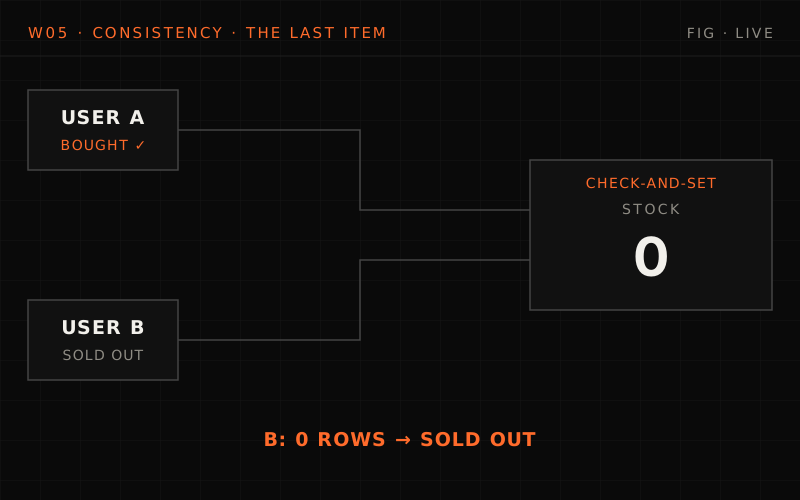
Week 4's cached inventory lets two buyers both see the last item and sell it twice; the fixes are locking, check-and-set at commit, or cancelling one order. The week's other problems are a transfer that debits A but can't credit B, two offline edits where last-write-wins loses one, and two nodes that both think they lead. The five days answer them: consistency models, sagas with compensation, durable orchestration, vector clocks and CRDTs, and leader election with fencing tokens.
The Week Ahead#
Theme: "Understand the Cost of Consistency"#
- Day 1: Consistency Models
- Strong vs Eventual vs Causal
- What does "consistent" actually mean?
- Read-your-writes, monotonic reads
- CAP theorem in practice (not theory)
- Day 2: Distributed Transactions — Saga Pattern
- Why 2PC is avoided in microservices
- Choreography vs Orchestration
- Compensation and rollback
- Handling compensation failures
- Day 3: Saga Orchestration Deep Dive
- State machines for workflows
- Temporal/Cadence workflow engines
- Durable execution guarantees
- Versioning and evolution
- Day 4: Conflict Resolution
- Last-write-wins problems
- Vector clocks and version vectors
- CRDTs for automatic resolution
- Merge strategies for business data
- Day 5: Leader Election and Coordination
- Why leader election is hard
- Fencing tokens and split-brain
- ZooKeeper, etcd, Consul patterns
- Distributed locks in practice
Why consistency, why now
Q1/2 Week 4 cached inventory for 30 seconds. Users A and B both see "1 item in stock" and click Buy at the same moment. What is the real problem?
Answer & explanation
Answer: C
Caching traded consistency for speed, which is acceptable for showing a page but not for a critical operation like decrementing stock. A shorter TTL only shrinks the window; any read-then-write on stale data can still oversell.
Q2/2 Which statement best captures this week's theme, "Understand the Cost of Consistency"?
Answer & explanation
Answer: A
The week is about trade-offs: display data can be eventually consistent while checkout or money transfers need stronger guarantees. Making everything strongly consistent is correct but needlessly slow; making everything eventual breaks critical paths.
Why This Matters Now#
The Inventory Problem (Revisited)#
In Week 4, we cached inventory with a 30-second TTL. But what happens at checkout?
- T+0.0s — Inventory = 1 (truth in database)
- T+0.0s — Cache shows 1 (cached value)
- T+0.1s — User A clicks "Buy" → Sees 1 in stock
- T+0.2s — User B clicks "Buy" → Sees 1 in stock
- T+0.3s — User A's order processes → Inventory = 0
- T+0.4s — User B's order processes → Inventory = -1 ???
RESULT: We sold 2 items when we only had 1!
Options:
1. Strong consistency: Lock inventory during checkout — Slower, but correct
2. Optimistic concurrency: Check-and-set at commit — Faster, occasional failures
3. Compensation: Detect oversell, cancel one order — Complex, bad user experience
Which one? Depends on your consistency requirements.
The Money Transfer Problem#
Transfer $100 from Account A to Account B:
- Step 1: Debit $100 from Account A — ok
- Step 2: Credit $100 to Account B — failed (Service B down!)
RESULT: $100 disappeared!
| In a single database | In microservices |
|---|---|
| ROLLBACK | ??? |
This is why we need Sagas.
The Collaborative Editing Problem#
Google Docs scenario:
- User A (offline): Types "Hello World" at position 0
- User B (offline): Types "Goodbye" at position 0
Both sync at the same time.
- Expected result: Both edits appear
- Actual result with last-write-wins: One edit lost!
Who wins? How do you merge? This is why we need CRDTs.
The Leader Election Problem#
Distributed job scheduler:
- Node A thinks it's the leader
- Node B thinks it's the leader
- Both schedule the same job!
Result: Job runs twice, data corrupted
Or worse:
- Network partition heals
- Both leaders have made different decisions
- System state is inconsistent
How do you ensure exactly one leader? This is why leader election is hard.
What You'll Build This Week#
Day 1: Consistency-Aware Inventory System#
Note: the samples call fetch_one, as in the databases library (or a thin wrapper with that method). With asyncpg the equivalent is fetchrow, which returns a Record.
# Preview: Consistency levels for different operations

class InventoryService:
    async def check_availability(self, product_id: str) -> int:
        """
        Display inventory count.
        Eventual consistency is fine — cached value OK.
        """
        return await self.cache.get(f"inventory:{product_id}")

    async def reserve_inventory(self, product_id: str, quantity: int) -> bool:
        """
        Reserve inventory for checkout.
        STRONG consistency required — must read from primary.
        """
        async with self.db.transaction(isolation="SERIALIZABLE"):
            current = await self.db.fetch_one(
                "SELECT quantity FROM inventory WHERE product_id = $1 FOR UPDATE",
                product_id
            )
            if current['quantity'] >= quantity:
                await self.db.execute(
                    "UPDATE inventory SET quantity = quantity - $2 WHERE product_id = $1",
                    product_id, quantity
                )
                return True
            return False
Day 2: Order Processing Saga#
# Preview: Saga pattern for order processing

class OrderSaga:
    """
    Order processing with compensation.

    Steps:
    1. Reserve inventory
    2. Charge payment
    3. Create shipment

    If any step fails, compensate previous steps.
    """

    async def execute(self, order: Order) -> SagaResult:
        # Step 1: Reserve inventory
        reservation = await self.inventory.reserve(order.items)
        if not reservation.success:
            return SagaResult.failed("Insufficient inventory")

        # Step 2: Charge payment
        payment = await self.payment.charge(order.total)
        if not payment.success:
            # COMPENSATE: Release inventory
            await self.inventory.release(reservation.id)
            return SagaResult.failed("Payment failed")

        # Step 3: Create shipment
        shipment = await self.shipping.create(order)
        if not shipment.success:
            # COMPENSATE: Refund payment, release inventory
            await self.payment.refund(payment.id)
            await self.inventory.release(reservation.id)
            return SagaResult.failed("Shipment failed")

        return SagaResult.success(order_id=order.id)
Day 3: Workflow Orchestration#
# Preview: Temporal-style workflow

@workflow.defn
class OrderWorkflow:
    """
    Durable workflow for order processing.

    Survives crashes, retries automatically. Workflow progress is
    recorded once; activities are at-least-once, so keep them idempotent.
    """

    @workflow.run
    async def run(self, order: Order) -> OrderResult:
        # Each activity is durable — survives crashes
        reservation = await workflow.execute_activity(
            reserve_inventory,
            order.items,
            start_to_close_timeout=timedelta(seconds=30)
        )

        try:
            payment = await workflow.execute_activity(
                charge_payment,
                order.total,
                start_to_close_timeout=timedelta(seconds=60)
            )
        except ActivityError:  # e.g. payment declined (activity failures arrive wrapped)
            # Compensation activity
            await workflow.execute_activity(
                release_inventory,
                reservation.id,
                start_to_close_timeout=timedelta(seconds=30)
            )
            raise

        # Continue with shipment...
Day 4: Shopping Cart Merge#
# Preview: CRDT-based shopping cart

class ShoppingCartCRDT:
    """
    Conflict-free shopping cart that works offline.

    Uses OR-Set (Observed-Remove Set) for items.
    Automatically merges without conflicts.
    """

    def __init__(self):
        self.items = ORSet()  # CRDT set

    def add_item(self, product_id: str, quantity: int):
        """Add item — always succeeds, never conflicts."""
        self.items.add((product_id, quantity, unique_tag()))

    def remove_item(self, product_id: str):
        """Remove item — only removes observed additions."""
        for item in self.items.lookup(product_id):
            self.items.remove(item)

    def merge(self, other: 'ShoppingCartCRDT'):
        """
        Merge two carts — automatic conflict resolution.

        If User A adds item X on phone (offline)
        And User B adds item Y on laptop (offline)
        Both items appear after merge!
        """
        self.items.merge(other.items)
Day 5: Distributed Lock with Fencing#
# Preview: Safe distributed locking

class FencedLockService:
    """
    Distributed lock with fencing tokens.

    Prevents split-brain: If two nodes think they hold the lock,
    only the one with the higher fencing token succeeds.
    """

    async def acquire(self, resource: str, holder: str) -> Lock:
        """Acquire lock and get fencing token."""
        lock = await self.redis.set(
            f"lock:{resource}",
            holder,
            nx=True,
            ex=30
        )
        if lock:
            # Get monotonically increasing fencing token
            token = await self.redis.incr(f"fence:{resource}")
            return Lock(resource=resource, holder=holder, fence_token=token)
        return None

    async def execute_with_lock(
        self,
        resource: str,
        operation: Callable,
        fence_token: int
    ):
        """
        Execute operation with fencing token.

        Storage layer validates token — rejects stale operations.
        """
        await self.storage.execute(
            operation,
            fence_token=fence_token  # Storage validates this
        )
Connecting to Previous Weeks#
Building on Week 1-4 Foundations#
- Week 1 (Foundations)
- Partitioning: Data spread across nodes
- Replication: Copies for availability
- Question raised: How do replicas stay in sync?
- Week 2 (Failure-First)
- Idempotency: Safe retries
- Timeouts: Bounding uncertainty
- Question raised: What if operation partially succeeds?
- Week 3 (Messaging)
- At-least-once: Messages may duplicate
- Transactional outbox: Atomic publish
- Question raised: How to maintain order across services?
- Week 4 (Caching)
- Eventual consistency: Stale data acceptable
- Invalidation: Propagating changes
- Question raised: When is eventual NOT enough?
- Week 5 (This Week) — ANSWERS all these questions!
- How replicas stay in sync → Consistency models
- Partial success handling → Saga pattern
- Order across services → Orchestration
- When eventual isn't enough → Strong consistency
Key Concepts to Internalize#
The Consistency Spectrum#
| Model (strong → eventual) | Guarantee |
|---|---|
| Linearizable | "One copy" |
| Sequential Consistency | "All see same order" |
| Causal Consistency | "Cause before effect" |
| Read-your-writes | "See your own writes" |
| Eventual | "Eventually converges" |
- Cost: HIGH (strong consistency) ←→ LOW (eventual consistency)
- Speed: SLOW (strong consistency) ←→ FAST (eventual consistency)
The CAP Theorem (Practical View)#
You don't "choose 2 of 3" at design time. You choose per-operation at runtime.
Example: E-commerce platform
| Operation | Consistency needed | Availability needed | Decision |
|---|---|---|---|
| Browse products | Low (eventual OK) | High (must work) | AP (cache reads, tolerate stale) |
| Place order | High (no oversell) | Medium (brief unavailability OK) | CP (strong consistency, accept latency) |
| View order history | Medium (read-your-writes) | High | Causal consistency |
The Saga Pattern#
2PC (Two-Phase Commit)
- Coordinator asks: "Ready to commit?"
- All participants respond: "Yes"
- Coordinator says: "Commit!"
- All participants commit
- Problem: Participants hold locks until the coordinator decides
- Problem: Coordinator crash after prepare leaves participants in doubt
- Problem: Blocking — everyone waits
Result: Rarely used in microservices
SAGA
- Execute T1 (has compensating C1)
- Execute T2 (has compensating C2)
- Execute T3 (has compensating C3)
If T3 fails:
-
Execute C2 (undo T2)
-
Execute C1 (undo T1)
-
Advantage: No distributed locks
-
Advantage: Each step is independent
Result: Standard pattern in microservices
Interview Patterns This Week#
Common Questions You'll Answer#
Q: "How do you prevent overselling inventory?"
A: "Use optimistic concurrency with version checks, or pessimistic locking with SELECT FOR UPDATE. The choice depends on contention levels..."
Q: "How would you implement a money transfer across banks?"
A: "I'd use the Saga pattern with compensation. Debit first, then credit. If credit fails, issue compensating refund..."
Q: "What happens if your distributed lock holder crashes?"
A: "The lock has a TTL and will expire. But the dangerous case is if the holder is just slow — that's why we use fencing tokens..."
Q: "How do you handle conflicts in offline-first apps?"
A: "Depends on the data. For counters, I'd use a CRDT like G-Counter. For sets, an OR-Set. For arbitrary data, we might need application-level merge logic..."
Q: "When would you use strong consistency over eventual?"
A: "For financial transactions, inventory reservations, unique constraint enforcement. Anywhere that stale data leads to business-critical errors..."
Preparing for the Week#
Mindset Shift#
| From | To |
|---|---|
| "Make it fast" | "Make it correct, then fast" |
| "Cache everything" | "Cache what can be stale" |
| "Retry on failure" | "Compensate on failure" |
| "One database" | "Consistency across services" |
| "Lock and update" | "Optimistic concurrency" |
Key Questions to Keep in Mind#
As you go through each day, ask:
- What consistency level does this operation need?
- What happens if this operation partially succeeds?
- How do we detect and resolve conflicts?
- What's the compensation strategy if we need to rollback?
- Is there a single leader, or can multiple nodes act?
Quick Reference: The Week's Tools#
| Concept | Tools/Technologies |
|---|---|
| Consistency | PostgreSQL isolation levels, CockroachDB, Spanner |
| Sagas | Temporal, Cadence, AWS Step Functions, custom |
| Coordination | ZooKeeper, etcd, Consul, Redis (limited) |
| CRDTs | Riak, Redis Active-Active (Redis Software/Cloud), Automerge, Yjs |
| Distributed Locks | Redlock, ZooKeeper recipes, etcd leases |
Daily Time Investment#
- Day 1: Consistency Models — 90 minutes
- Core reading — 45 min
- Implementation review — 30 min
- Practice problems — 15 min
- Day 2: Saga Pattern — 90 minutes
- Core reading — 45 min
- Build simple saga — 30 min
- Interview practice — 15 min
- Day 3: Orchestration — 90 minutes
- Core reading — 40 min
- Temporal patterns — 35 min
- Compare approaches — 15 min
- Day 4: Conflict Resolution — 90 minutes
- Core reading — 45 min
- CRDT implementation — 30 min
- Practice problems — 15 min
- Day 5: Leader Election — 90 minutes
- Core reading — 45 min
- Distributed lock patterns — 30 min
- Failure scenario analysis — 15 min
What Success Looks Like#
By the end of Week 5, you should be able to:
- Explain the trade-offs between consistency models
- Design a Saga for any multi-service transaction
- Implement compensation logic for rollback scenarios
- Choose between choreography and orchestration
- Understand when to use CRDTs vs manual merge
- Implement a distributed lock with fencing tokens
- Explain split-brain and how to prevent it
- Design systems that degrade gracefully under partition
- Answer any consistency-related interview question
Let's Begin#
Week 5 tackles the hardest problems in distributed systems. These concepts separate junior engineers who "make it work" from senior engineers who "make it correct."
After this week, you'll understand:
- Why distributed systems are fundamentally different from single-machine systems
- How to reason about consistency requirements for any operation
- The patterns that make complex distributed transactions possible
- How to coordinate multiple nodes safely
Day 1 starts with the foundation: Consistency Models. We'll learn what "consistent" actually means in distributed systems, and why it's more nuanced than you might think.
Ready to master consistency? Let's begin with Day 1: Consistency Models — understanding what consistency really means in distributed systems.
this lesson in shorts · 1
play them all →One idea from this lesson in about a minute each, made for your phone.

New lessons by email
New lessons, side quests and case files as they ship, at most once a week. No spam, unsubscribe anytime.
Discussion · …
Public: everyone reading this lesson sees comments. Be kind and keep it on the material.